



Bluegrass Lessons Course
Welcome to the Bluegrass Style page! Bluegrass music can be easily identified by its use of all-acoustic instruments, blazing techniques and unique storytelling. Some classic bluegrass music is usually played at a fast tempo which might make learning how to play guitar in the style seem a bit tricky. The great thing is, these bluegrass guitar lessons will take you step-by-step through all the techniques of playing guitar in the unique style.
If you need a refresher on any guitar technique listed below, be sure to check out the Guitar Fundamentals Course 1 and Acoustic Style Course 1. These courses are designed to help anyone at any skill level learn how to play guitar through beginner guitar lessons.
Top Artists


Bluegrass Rhythm Guitar
Here you’ll learn the fundamentals of Bluegrass guitar like standard strumming utilizing guitar chords essential to the style.


In this tutorial we'll explore the very basics of the iconic Bluegrass sound by first focusing on the most common chord choices and the classic sounding right hand strumming work. Bluegrass can ultimately get incredibly fast and technical, but even here at the early stages of the journey it's a fun and rewarding sound to explore. We'll learn a basic practice tune in G and play it along with a backing track.

In this tutorial we'll explore the basics of the iconic Bluegrass sound. This time we'll focus on another common group of chord voicings in the key of D. We'll apply the same classic right hand work using root chord strumming and finally use it all within the context of a fun Bluegrass practice tune with all the bells and whistles.


In this lesson series we'll walk you throught the basics of the Bluegrass style with a couple of rhythm examples and the necessities of your music collection to get started with this style.
Bluegrass Lead Guitar
In this section you'll learn how to add fills and flourishes to chords, plus some classic licks and riffs.

In this tutorial we'll explore some really fun introductory examples of bluegrass lead vocabulary. Bluegrass lead playing is closely tied to the chords you're soloing over, so we'll start out by building up a solid vocabulary over the ever present G chord. We'll break down, practice and play through three iconic licks and then we'll combine them all at the end to play your very first bluegrass solo.

In this tutorial we'll explore some more fun and highly useful examples of bluegrass lead vocabulary. Bluegrass lead playing is closely tied to the chords you're soloing over, so in this tutorial we'll build up a solid vocabulary over our C chord. We'll break down, practice and play through three iconic licks and then we'll combine them all at the end to play your very first bluegrass solo.

In this tutorial we're going to explore some more iconic bluegrass lead vocabulary. Bluegrass soloing is closely tied to the chords that are happening underneath the solo, so it's important to have a solid vocabulary for each of the most common chords. Today we'll explore three extremely useful licks over a D chord.


In this first tutorial in my Bluegrass Lick Library series is for the novice guitar player who wants to venture into the land of bluegrass guitar. I will give you nine simple licks that you can use over a standard I IV V chord progression in the key of G major. We will practice them one by one, then three at a time, and ultimately all of them one after the other. Good luck!

Bluegrass Lick Library G2 builds on the Bluegrass Lick Library G1 tutorial. Here I will increase the difficulty a little bit, still keeping it fairly simple as far as bluegrass goes. We will play over the same backing track as the G1 tutorial - G | C | D | G | - and I will show you nine more licks to add to your personal lick library.
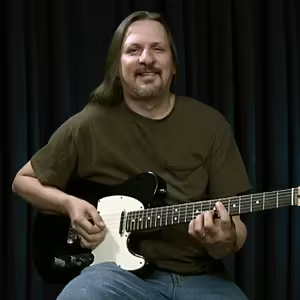

This tutorial on flatpicking was inspired by my earliest musical influences, and also the greatest flatpickers in history. The first lesson has a couple of licks for the G chord, then the next one I start in G and go to the 4 chord. Then I go back to the G chord for the third lesson, and in the last one I go to the 5 chord, and then back to the G chord to finish it up.
Lead Guitar Intermediate Vocabulary Building

In this tutorial we're going to kick our bluegrass soloing into a higher gear by exploring how to play over a changing chord progression. This will require that we know our basic bluegrass licks for the G, C and D chord really well. But don't worry, we'll review everything you need as we go, and then you can always go back and review those tutorials if you need some more time with any of them.

In this tutorial we're going to boost your bluegrass soloing skills by adding some powerful licks in the great key of E. The open position in this key really lends itself to some bluesy phrases so we'll explore four short licks that can be used on their own or strung together into a long and great sounding bluegrass phrase.

In this tutorial we'll boost your bluegrass soloing skills by adding some powerful licks in the great key of E. The open position in this key really lends itself to some bluesy phrases so we'll explore four short licks that can be used on their own or strung together into a long and great sounding bluegrass phrase.

In this tutorial we'll continue our journey into the wonderful world of Bluegrass soloing. This time we'll emphasis the bluesy influences that add a lot of extra depth and emotional complexity to the sound. We'll combine these new bluesy licks in the key of G with some of our standard licks for the C and the D chord and you'll experience that powerful combination of bluesy tension and the more peaceful sounding chord-based licks.
Rhythm Guitar Intermediate Technique & Skills

In this tutorial we'll take your bluegrass rhythm playing one step further by adding our alternating bass notes to a little chord family in the key of E. First we'll go through each of the chords individually and then at the end we'll use it all to play a fun Bluegrass practice tune with the band.

In this tutorial we'll continue our journey into the wonderful world of bluegrass this time by adding the instantly recognizable sound of alternating bass notes in our right hand. This requires a lot of precision in your strumming work, so it is both a powerful sound and a great workout for your right hand. We'll use it all within the context of a fun bluegrass practice tune.
Rhythm Guitar Advanced Technique & Skills

In this tutorial we'll explore some more advanced Bluegrass rhythm guitar tricks. We'll do this by combining our root/5 strumming with some classic sounding walk-downs and walk-ups to gracefully move between the different chords. We'll also work in some signature embellishments as well as the most iconic bluegrass lick of them all.

In this tutorial we'll venture further into the more advanced part of the bluegrass rhythm world. For our practice tune today we'll be in the key of C and we'll use a combination of root/5 strumming, stylistic embellishments, walk-ups and walk-downs as well as the most iconic bluegrass turnaround lick.
Bluegrass Techniques
Learn different picking techniques like crosspicking and synchopated strumming rhythms.

This tutorial on crosspicking was inspired by a subscriber in the forum, and in these lessons I'll get you started by showing you a simple pattern starting on different strings. The first one is using open strings, and starts on the 4th string. Then I'll show the roll starting on the 3rd string, the 5th string, and the 6th string. Then I'll put them all together, and crosspick from C to G.

This tutorial on crosspicking was inspired by a subscriber in the forum, and in these lessons I show you another pattern used for crosspicking. I'll show you the same pattern starting on different strings, and then put them into 3 exercises using the 1, 4, and 5 chords in the key of G. Then I'll show you the combinations for a 1, 4, 5, 1 progression, and there's even an alternate ending.

In this tutorial we're gonna look at two traditional bluegrass instruments and how they apply to regular guitar playing. We're gonna talk about the tuning, technique and style of both the banjo and the dobro and look at how you can work these sounds into your regular guitar playing. At the end of the tutorial we're gonna play through an old bluegrass tune using all the new techniques.
Essential Bluegrass Songs
Bluegrass music emerged in the 1940s, drawing from traditional music of immigrants from the British Isles (particularly Scotland, Ireland, and England). It also incorporates elements of jazz and Blues guitar. Bluegrass is distinct with its use of stringed instruments, including the mandolin, banjo, fiddle, guitar, and double bass. As you work through the songs below, some difficult and some easy guitar songs, you’ll definitely notice the influence from across cultures in Bluegrass music.


In this set of bluegrass song lessons, Mike Olekshy will teach "Get Up John", by Emmylou Harris. After setting up the song and talking about gear and tone, Mike will cover the main strumming rhythm and chorus rhythm on acoustic. Next up is are the mandolin fills adapted to electric: first the intro leads, then the two re-intro leads, then the outro leads. We'll do full and single guitar performances, and end with a jam along.


Tom will show you all the parts to this iconic bluegrass standard: the banjo intro, the rhythm guitar, the slide solo, and the outro.

Mike will show you the acoustic guitar part tuned to dropped D with a capo on the third fret to get some awesome sounding delta blues licks that combine bass notes with upper register chords.

Mike will show you this song in a Made Easy format, breaking down the progression to open chord shapes with a capo, and a simple strumming pattern.

Tom will show you all the great moves in this iconic acoustic, bluegrass tune by a legend in the genre. He covers the swingy blues rhythm and licks along with a fast double-time feel and some very fancy Travis-style finger picking.

This bluegrass standard is a treasury of hooks and driving rhythm combined to make one of the most memorable songs ever recorded. We'll walk slowly through the hooks and song parts until you've become a dueling master, never again to be bothered by those pesky banjo types! We'll look at the call-and-response format of the song, the G, C, and D chords and how to strum them, and of course the famous melody line.

Anders will show you all the classic bluegrass moves from the dramatic sounding single note intro, to the melody, the solos and the rhythm guitar plays the classic boom-chick strumming with lots of little embellishments and cool bass movement.
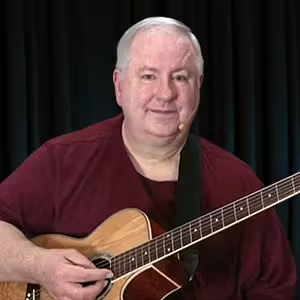

Old Joe Clark is a traditional bluegrass standard dating back to the 19th century. Here, three-finger "banjo-roll" style guitar picking is explained in great detail to get that fast, rolling sound on acoustic guitar. We take advantage of and use the open G triad tuning of strings 4, 3 and 2 to help us along. A fun, driving backing track is used to make the tune complete.
Bluegrass Artist Studies
The genre was popularized by Bill Monroe and his band, the Blue Grass Boys. The band's name derived from Monroe's home state of Kentucky, known as the "Bluegrass State.” This is how the name became synonymous with the musical style, Appalachian culture and the American South. Along with Monroe, and other Bluegrass greats like Doc Watson and Chet Atkins, take a look at how famous Bluegrass guitarists use these techniques to create amazing guitar sounds.

Several subscribers have indicated an interest in learning more about the Chet Atkins thumb and finger style, so this tutorial has been created to go into quite a bit of detail to show the learner how to learn it.


Tony Rice fuses many elements into one distinctive style. This series of lessons will take a look at some of the concepts used in his style: jazz-influenced chords, syncopated and varied rhythm playing, unique use of pentatonic scales, and chords in lead lines and chord substitutions. We'll put them all together into a solo that exploits all of the techniques.
FAQ
Is it hard to learn bluegrass guitar?
It can be challenging due to its fast pace and technical playing, but it's super rewarding once you get the hang of it.
What is the bluegrass guitar strum pattern?
It’s mostly about that “boom-chick” rhythm, combining bass notes and strums for a lively sound.
What is the best tuning for bluegrass?
Standard guitar tuning works fine, but open tunings like Open G can add some authentic twang.
What is bluegrass guitar style?
It involves a lot of fast-picking and rhythmic strumming, creating an energetic and driving sound.
What is the chord pattern for bluegrass?
Typically revolves around the I-IV-V chord progression, keeping it simple and spirited.
What strings do bluegrass players use?
Medium gauge strings are common for their balance of volume and playability.
What is the most important instrument in bluegrass music?
The guitar is quintessential to the Bluegrass style, often stealing the show in Bluegrass bands.
What is the most popular instrument used in bluegrass music?
The fiddle and mandolin are super popular, adding quick, lively melodies to the mix.
What is a bluegrass guitar called?
It’s just called a flat-top acoustic guitar, nothing too fancy.
What are the Big Five bluegrass instruments?
The big five are the banjo, fiddle, guitar, mandolin, and upright bass. They make the classic bluegrass sound come to life!
Need Extra Help with your playing?

Book A Private Lesson
Schedule a 30 or 60 minute lesson with a coach who can offer advice and guidance to improve your playing.

Request A Custom Lesson Plan
Whether you’re just starting to play or returning from a long break, a guided practice plan can get you to where you want to be sooner.